Adrian Johnson Farm Dispersal Sale Report
Following his decision to retire from farming and travel the world with his wife, Adrian Johnson kindly instructed Howkins & Harrison to


There is a renewed focus from central Government on the provision of infrastructure, including new roads and rail routes. Amongst the headlines and ‘big picture’ issues, one area of importance often disregarded by the media is the effect of any such scheme on the livelihoods of farmers situated along the route. Alex Brown, a recent graduate recruit to Howkins & Harrison, has first-hand experience of such a scheme as his family farm has been directly impacted by HS2. The question arose – would a change in field shape due to compulsory acquisition impact on farm efficiency? Alex has used this scheme and his experience to consider the impact of such projects on the farming productivity of retained fields post-scheme and highlights how this is often not given sufficient consideration in the context of compulsory purchase schemes and compensation.
This summer, through an analysis of recorded tractor data and in-field time recording, Alex explored the key characteristics of a field which influence its productivity ratio (the proportion of total field time spent in valuable productive activity) and analysed the impact of changes in field shape, due to new infrastructure, on operational efficiency.
At its core, the productivity and efficiency of a field is dependent on three key factors: shape, size, and boundary.
With headland turning time being classified as un-productive, one of the most significant elements impacting efficiency is the geometry and width of a field’s headland turning area. Evidence suggests that fields of ‘irregular shapes’ have more complicated coverage paths, thereby increasing time-requirements per turn and resulting in greater inefficiencies. In addition to time efficiency, area-coverage efficiency is also dependent on field shape, with more complicated geometries resulting in increased overlapping and gaps.
An important factor in operational efficiency is the number of turns required by the tractor-implement combination. As such, shortening the length of a cultivated field and increasing the prominence of the headland compared to the main part of the field affects the ratio between productive working time and non-working time of the tractor. In other words, a farmer cultivating a shorter field will require more headland turns per acre than a longer field with the same width. As a result, a greater percentage of the overall operational time will be spent in an unproductive state, at lower speeds, with increased process defects, thereby reducing efficiency.
The type/nature of the field boundary also had a great impact on the efficiency and productivity of the analysed fields. In-field time recording indicated that a field with a wooden post and rail fence boundary resulted in a much slower and cautious headland turn when compared to a field with a hedged or ditched boundary.

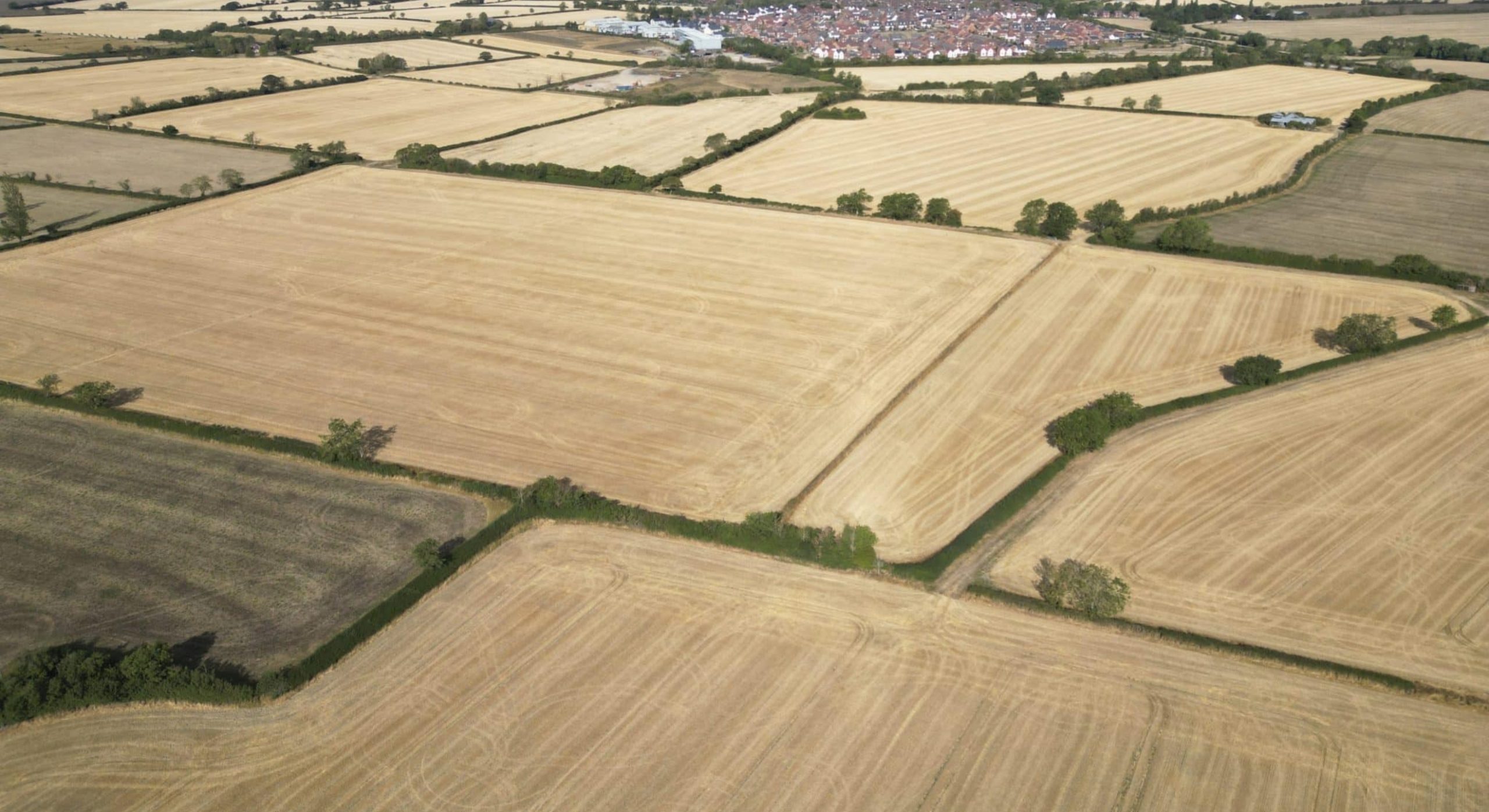
Fields were originally set out at the time of the enclosures and their size and shape reflected a number of factors including topography and soil type. They were, however, generally rectangular where possible. Whilst a lot of field boundaries have been removed in the last 100 years to aid efficiency, the field pattern has generally retained its broadly rectangular form. New infrastructure, such as HS2, does not necessarily respect this form and often cuts through diagonally, creating fields with triangular shapes. Should the shape of a headland change as a result of a compulsory purchase scheme and increase the amount of time a tractor takes to complete a turn (e.g., the angle of a headland changing from being square (90°) to acutely angled in relation to the rest of the field), the ratio of valuable operating time to total time will be weakened, thereby resulting in loss of efficiency and increase in operating costs.
If severance occurs at 90 degrees to the field boundaries and a permanent divide splits a field into two shorter regularly shaped fields, the total time spent in the headland will be doubled and the ratio of input to output in each field will be increased, thereby impacting the productivity ratio. As such, in a similar manner to shape, changing the size of a field makes it less economically efficient.
Considering that boundary fencing is almost always installed for infrastructure, the erection of new fencing as a replacement for an existing hedge/ditched boundary would arguably decrease the productivity of infield operations, thereby contributing to the negative impact of severance.

Research on the ‘pre-scheme’ and ‘post-scheme’ productivity rating for a 33-acre plot of arable land impacted by HS2 (reduced in size to 5.1 acres) seemingly confirmed this, with a 38.6% productivity loss recorded (68.6% productive time down to 30%) because of its changed field structure. In light of the equivalence principle, which forms the backbone of all compensation claims and states that compensation should ‘put the injured party back into the position in which they would have been had the event not occurred’, one might suggest that more work is required within the existing compensation structure to account for this efficiency loss on future schemes.
Howkins & Harrison has several professionals with expert knowledge of compulsory purchase and infrastructure, please contact your nearest office for advice.


Following his decision to retire from farming and travel the world with his wife, Adrian Johnson kindly instructed Howkins & Harrison to
The agricultural sector continues to evolve at pace. Changing policy frameworks, market pressures and the growing need for operational ef...

The winter of 2001 remains memorable, not only because the UK was dealing with the foot and mouth epidemic that significantly affected


"*" indicates required fields